
Upper Arlington Resident Lookup Sources
No official system supplies a full roster of Upper Arlington households. A resident lookup works best when the question is narrow: a parcel connection, a named elector, a court case, or a dated historical event. County and state systems answer different questions, so a result from one is a lead to test, not a complete personal profile.
| Record | What It Confirms | Where | Access |
|---|---|---|---|
| Auditor property record | Parcel association, owner label, transfer and tax context | Franklin County Auditor | Search by owner, address, or parcel; not a household roll |
| Recorder instrument | Party link to a deed, mortgage, lien, or plat | Franklin County Recorder | Use party, parcel, or legal description, not street address |
| Tax property record | Tax-side parcel context | Franklin County Treasurer | Name, address, or parcel search; verify with the county record |
| Voter registration | Named elector, registration, precinct, and polling context | Ohio My Voter Information | First name, last name, and county required; protected records excluded |
| Court record | Named party and case history in the proper court | Franklin County CIO | Online index first, then the owning clerk for a record or copy |
| Historic death source | Death fact and a certificate-location clue | Ohio History Connection | Historical research index, not a current-location source |
Start with the record closest to the question. An address or parcel question belongs with the Auditor. A case question belongs with the court that created it. A historic death lead belongs with the archives or vital-record custodian, then with probate or an obituary where appropriate.
Upper Arlington Records Have Distinct Roles
Upper Arlington sits in Franklin County, so the local path is split among county custodians and city records. The useful comparison is purpose, not volume. The Auditor connects an address to a parcel; the Recorder connects parties and legal land descriptions to instruments; the Treasurer supplies tax-side context; and the voter tool checks one named registration.
| Official source | Best use | Important boundary |
|---|---|---|
| Auditor | Current property location and parcel clues | An owner label does not identify all people at the site |
| Recorder | Recorded instrument chronology | Street addresses are not its document-index key |
| Parcel Viewer | Map location and adjoining-parcel context | Map proximity is not a personal relationship |
| CML directory collection | Dated, historic listed occupancy | A listing is not proof of ownership or present residence |
| Voter lookup | One named elector and precinct | It does not browse a street or household |
This difference is an Upper Arlington quirk with practical consequences: the Recorder does not index a deed by street address, while the Auditor does. Move from address to parcel or legal description before checking an instrument.
Check an Upper Arlington Voter Record
Ohio My Voter Information is a name-based check, not a browseable residents directory. Enter the person’s first name, last name, and Franklin County. The state suggests trying a derivative first name, former last name, or a prior Ohio county address when a search does not return a result. Compare the returned name, county, residence and precinct before treating it as the right person.
Ohio Revised Code sections 3503.13 and 3503.153 make specified voter information public while protecting Social Security fragments, identification numbers, telephone and email information, confidential registration, protected-worker addresses, proof of citizenship, and other protected data. Voter history does not reveal ballot choices. A dated historical question may instead call for the Secretary of State’s DATA Act voter snapshots or a Board of Elections request under the applicable rules.
Upper Arlington Court Lookup Match
One name can appear in more than one court, and Upper Arlington has no universal court index. Case Information Online offers Name Search, Case Search, and Advanced Search for Common Pleas General Division, Domestic Relations, and Tenth District appellate matters. Its name route has last name, first name, middle initial, court, and filed-date fields. Its case route uses year, case type, and sequence.
The separate Franklin County Municipal Court Clerk search can begin with a name, case number, or ticket number. Optional narrowing includes middle name, date of birth, party type, case type, and year. Probate handles estates, guardianships, marriage licenses, name changes, and other probate matters. Upper Arlington Mayor’s Court is a separate municipal-code or traffic route where applicable. Select the custodian first, then read party role, case type, date, and docket details together.
For the Municipal Court interface, use the Clerk’s published search rather than a general web result. It shows the name, case, and ticket starting points that make a record-specific query manageable.
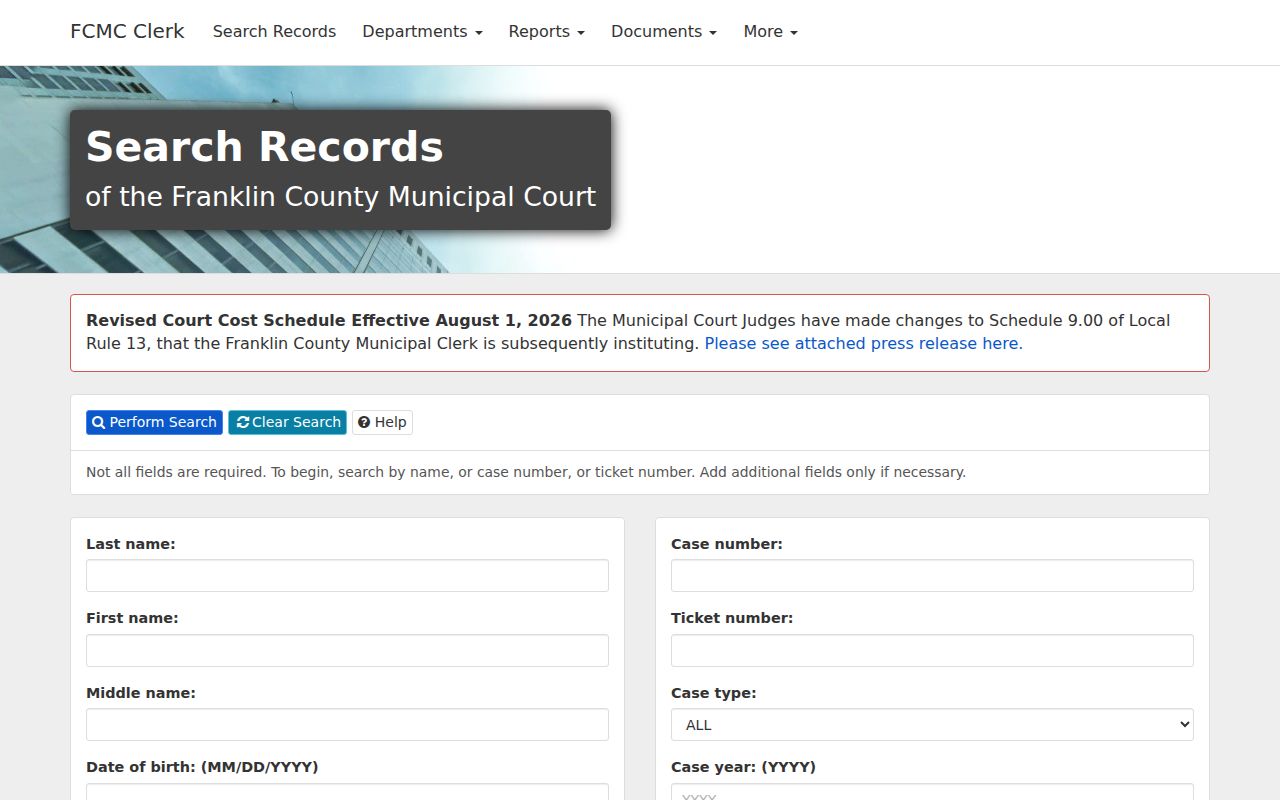
A case result identifies a court trail. It is not proof of a current address, and the clerk controls access to the original file, restricted material, and any certified copy.
Verify an Upper Arlington Resident Record
Cross-check at least two independent records when the distinction matters. Save the exact spelling, middle initial, date range, county, parcel number, or case number as you go. A similar name alone is weak evidence, especially when an old directory uses initials or a court index has several parties with the same surname.
- Anchor a property question with the Auditor’s owner, address, or parcel search, and record the parcel number and legal description.
- Check the Recorder by party, parcel, document clue, or legal description. Compare the instrument date and names with the Auditor record.
- For a named elector, use the first-name, last-name, and Franklin County voter search, then compare the returned precinct and record context.
- Use the correct court or historic record only after the name, date, jurisdiction, and any parcel or case identifier agree. Request a specific document or copy from the owning custodian when it is needed.
- Docket
- A court’s running case record, showing filings and events. It is not automatically the full document file.
- Index and image
- An index points to a record by name, date, or number. An image is the scanned record itself and may have separate access limits.
- Certified copy
- A copy authenticated by the custodian. It differs from an archive research copy or an online index entry.
Historic Upper Arlington Death Records
The Ohio History Connection gives the historical path, not a replacement for current vital records. Its online death index includes Ohio Department of Health certificates for 1913–1944 and 1954–1970, plus Columbus Board of Health certificates for 1904–1908. Archive copies are research copies and are not certified. Current certified birth or death records use the appropriate registrar, including Columbus Public Health where its eligibility and coverage apply. Its published certified-copy charge is $25, so order only when a current certified record is actually needed.
For a historic request not found in the index, Ohio History Connection asks for first name, last name, year, and at least one further locator such as month or day, county, or certificate number. It warns that poor historic indexing can hide a record, so try reasonable name variants. A death fact can lead to an estate file, but it does not establish who lives at an address now.
Franklin County Probate Court is the next custodian for an estate, guardianship, marriage license, or related probate matter. Its published rates list regular paper copies at $0.10 per page and certified copies at $1 per page. The court’s record and access rules control each file.
Upper Arlington Names in Dated Records
A former classmate or family-history question belongs in the historic layer, not a present lookup. Columbus Metropolitan Library has searchable older Columbus and Ohio school and college yearbooks, city directories, phone books, news indexes, and obituary-request help. Its historical material can supply a date-specific clue that should then be compared with the relevant primary record.
For an address-based historic trail, the library’s 1911-and-later street sections identify listed occupants for a publication year, not owners. The fuller historical collection is described on the Upper Arlington city directory page. Use it with dated deeds, probate, maps, and released census material instead of treating a single listing as an unbroken residence history.
Keep Ohio DRC Results in Context
The state’s Department of Rehabilitation and Correction search is a custody and supervision resource, not an Upper Arlington resident directory. It can search by name, county of commitment, residential county, ZIP, status, hearing month, or offender number. Residential county and ZIP apply only to stated supervision categories and describe the last recorded information, which can lag a move.
The Ohio DRC Offender Search is therefore used only for a narrow, lawful record question. Its result fields can include identity details, status, admission or institution information, and parole or supervision material. Do not treat any listed county or ZIP as a present location, and do not use a result to track or confront a person.
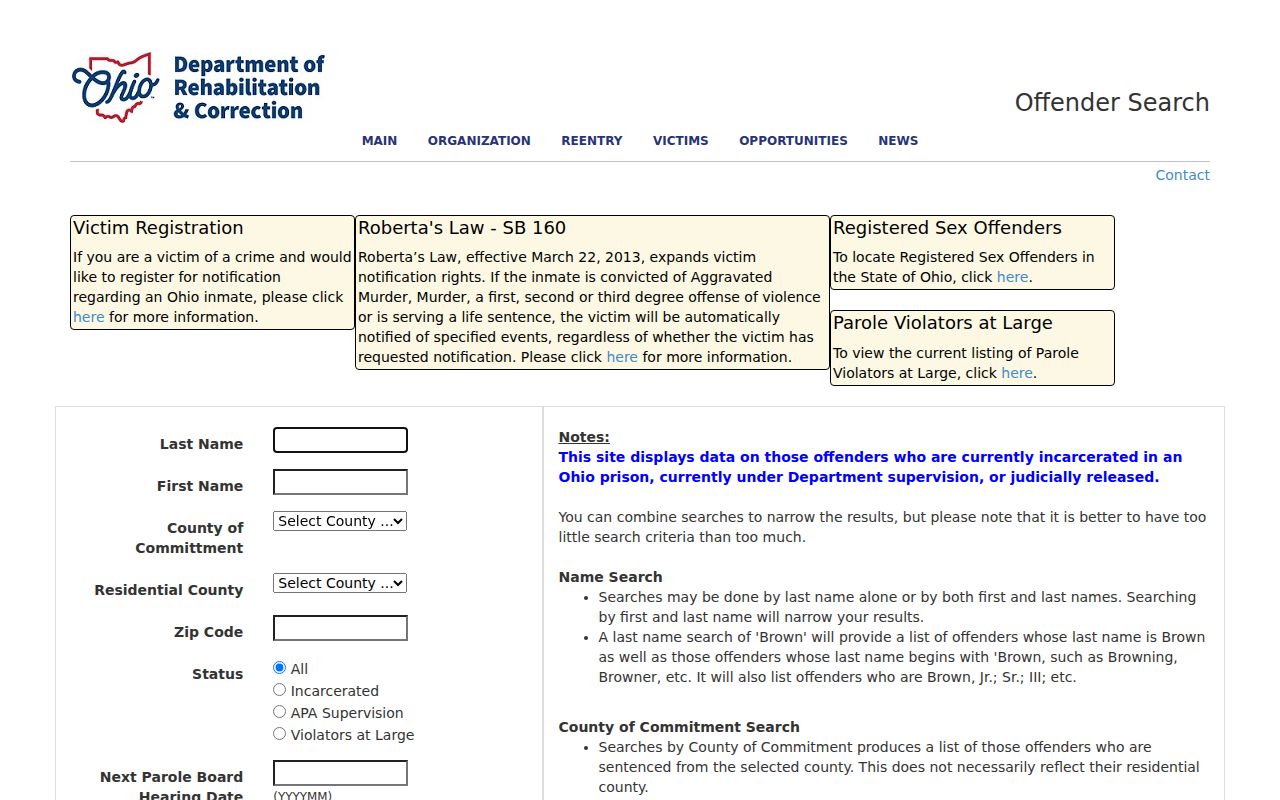
When a case, custody, or identity question remains uncertain, the original court, clerk, or agency is the source that can explain the record and its limits.
Upper Arlington Resident Lookup Limits
Ohio public-record access does not defeat a confidentiality rule, sealing order, or safety program. Safe at Home lets eligible survivors use a substitute address with government agencies and voter registration. Under R.C. 111.431, a property-confidentiality notice can require linked county property records to withhold identity through property identifiers and redact street address, parcel number, and legal description from the public version.
Do not try to rebuild a protected address from related records. Correct a demonstrable error with the office that created it, rather than with a copied index. Ohio has no verified general consumer deletion law for public records; R.C. Chapter 1354 is a voluntary cybersecurity safe harbor, not a universal privacy opt-out. A narrow public-record request under R.C. 149.43 should identify the record type, date span, and parcel, case, or document number when known.
Lawful use. Use official records for lawful personal, family-history, estate, civic, or scam-verification questions. R.C. 2903.211 and R.C. 2917.21 address menacing by stalking and telecommunications harassment; never use a record to stalk, harass, intimidate, or harm another person.